


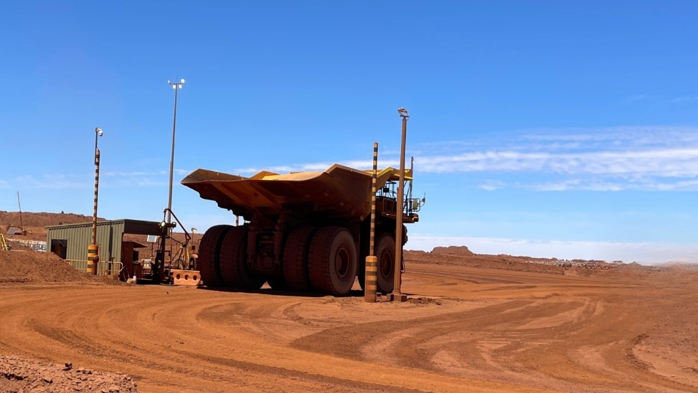

Author: Kevin Dagenais, CEO, Cascadia Scientific
This article explores how unlocking the often-unused bottom third of a haul truck’s fuel tank - through safely optimized refuel dispatch - can translate into meaningful gains in productivity, efficiency, and operational reliability for modern mining operations.
Introduction - Tapping into the Bottom 1/3rd
When I introduce the idea, and the financial impact, of “optimized refuel dispatch” to people outside mining, the reaction is often confusion or outright disbelief. For most motorists, the question of when to refuel was answered long ago: you stop when the gauge gets close to empty. So why does fueling strategy still constrain performance at some of the world’s most advanced mining operations?
This article explains what makes refueling uniquely complex in load-haul environments and how safely optimized refuel dispatch can unlock the bottom third of the tank—translating into more productive hours, fewer disruptions, and a measurable lift in site productivity

On-Board Tank Level Sensing
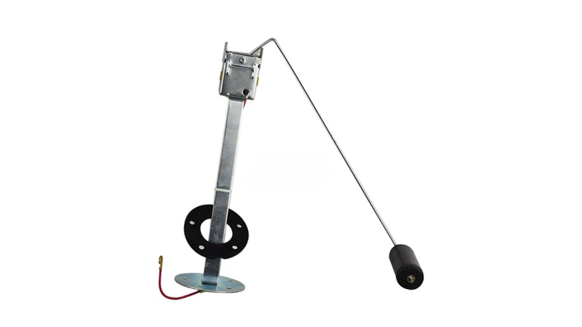
It’s been more than a century since the first mechanical dashboard-mounted fuel gauges appeared in the 1914 Studebaker Six Sedans. These were a welcomed improvement to the dip sticks they replaced, and while far less sophisticated than modern electrical instruments, performed the same task. With more than 100 years to refine these devices, it is somewhat surprising that the constraint preventing mining operations from optimizing their refueling practice is the lack of a reliable fuel tank level sensor.
Mining is Different
The reality is slightly more nuanced when you consider the harsh reality of mining environments, the operational duty cycle of mining haul trucks and that nearly every component on a haul truck will need periodic replacement. When sensors do fail, the economics often don’t justify stopping a machine to make the repair.
Further complicating things is the fact that dynamic dispatching systems are responsible for determining the circumstances under which a truck is sent for fuel. It’s not enough for the operator to have a view of the gauge, but rather for a digital interpretation of the tank level to be captured and transmitted to a dispatch system directing traffic.
Common Practice
The reality is slightly more nuanced when you consider the harsh reality of mining environments, the operational duty cycle of mining haul trucks and that nearly every component on a haul truck will need periodic replacement. When sensors do fail, the economics often don’t justify stopping a machine to make the repair.
Further complicating things is the fact that dynamic dispatching systems are responsible for determining the circumstances under which a truck is sent for fuel. It’s not enough for the operator to have a view of the gauge, but rather for a digital interpretation of the tank level to be captured and transmitted to a dispatch system directing traffic.
The Cost and the Opportunity
A time-based strategy has the advantage of simplicity and safety. If the number of operating hours selected for the refuel interval is less than the number of hours required to consume a tank’s worth of fuel, machines will rarely, if ever, run empty. Trucks unexpectedly losing motive power in an active mining area for lack of fuel produce both safety and financial risks. To ensure these events are exceedingly rare, a large safety margin is built into these time-based strategies. The downside of the approach is that subject to typical utilization, trucks will burn far less than the maximum volume during the refuel interval. Put in other words, “Always Safe = Typically Conservative”. This means machines will return to the fuel bay far sooner than necessary with large quantities of fuel on board. The images below clearly illustrate this phenomenon.
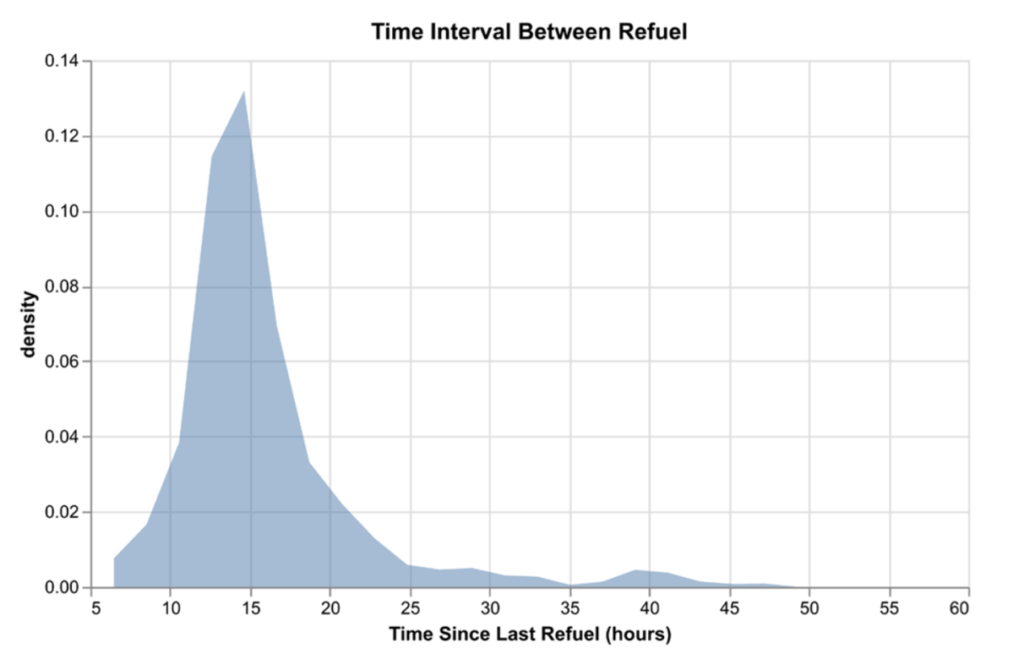
Built using refueling data from a large Copper Mine running a fleet of Komatsu 930E Haul trucks, the above distribution reflects the successful implementation of a “refuel to time” strategy. The distribution is centered around 14 operating hours and falls off dramatically to either side. We never observe refueling events fewer than 6 hours apart, and the small number of refueling events separated by days are likely related to machines that are out of production. The same data set was used to develop a histogram for the distribution of refuel events by percentage fuel remaining on board.
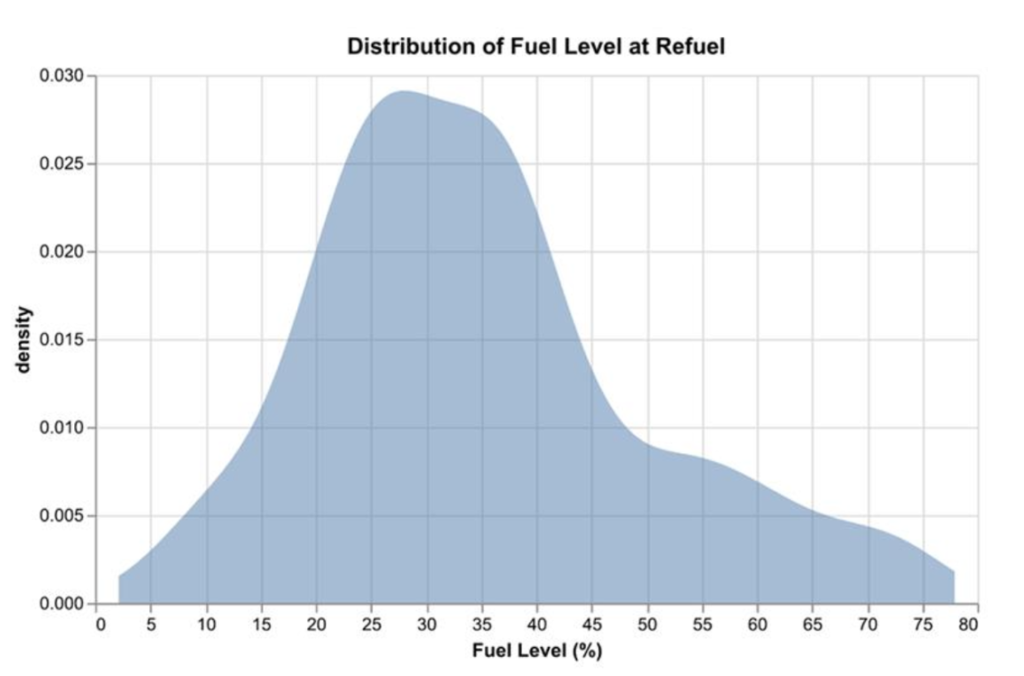
This distribution perfectly captures the nature of the opportunity. On average, trucks are stopping for fuel with a third of a tank remaining and it is not uncommon to observe fuel stops with the tank half full. Further, despite the built-in conservatism we observe a meaningful number of fueling events completed with between 5% and 10% fuel remaining.
Some simple math can be used to quantify to economic opportunity. Let’s examine the same data set used to produce the above histograms. Assuming an hourly value of productive haulage at $800 USD. The unit economics related to the current refuel practice is characterized below:
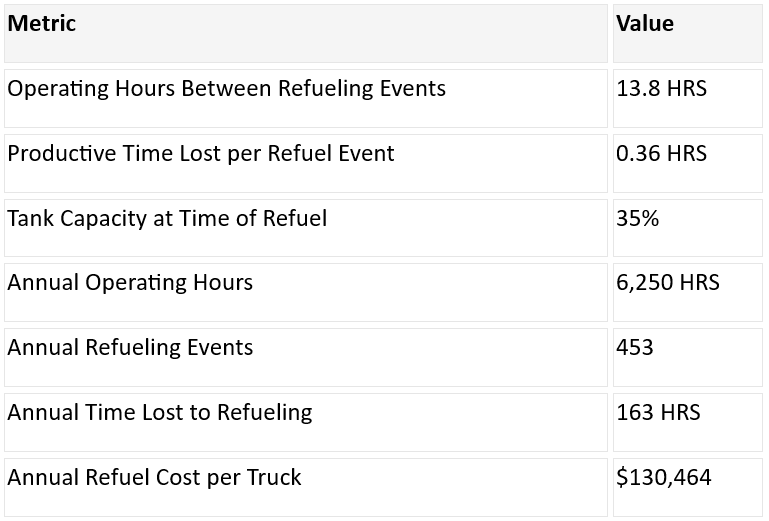
Next, lets assume that successful implementation of an optimized refuel dispatch strategy that safely delivered a mean tank volume at refuel of 22%. In this scenario, the effective tank capacity is increased by 21.5% (14% increase / 64% tank effective capacity). By increasing the effective tank capacity, by this amount, we increase the average time between refueling events by 17.7% thereby eliminating, on average, 17.7% of refuel stops. The newly optimized operation results in the following statistics:
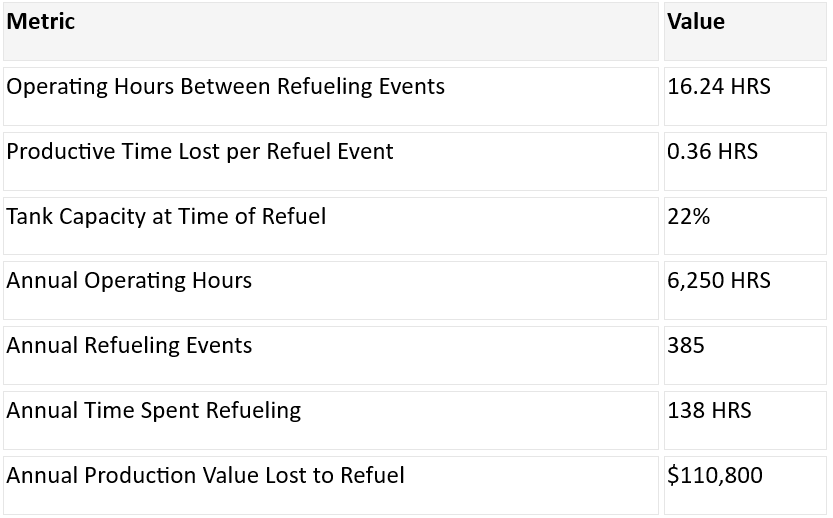
The difference in the two scenarios, for a single illustrative truck is $19,584, and in a haul truck constrained environment represents nearly a half percent productivity uplift. Assuming a fleet of 50 trucks, the annual value of the additional trucking time approaches $1M. Keep in mind this extra material movement has been unlocked simply by improving the timing of refuel dispatching.
For mine sites that experience queuing at fuel stops, this impact will also reduce demand on refueling infrastructure and is likely to produce additional production gains by reducing the average time of a refuel stop.
Lastly, we must consider the savings arising from avoided run-to-empty events. It is difficult to put a firm number on this value and the liability arising from the events makes data harder to come by. Despite this, it is not hard to imagine that the combined costs associated with unplanned truck downtime, potential disruption to an active haul road and related maintenance costs could quickly swell to the tens of thousands per event. If a fuel out event results in an injury or significant equipment damage, these numbers get larger still.
Safely Optimized Refuel Dispatch
With an understanding of the opportunity, we can turn our attention to solutions. Cascadia Scientific provides customer with an “Energy and Work” intelligence platform. Energy in the form of diesel fuel is accurately measured using on-board fuel flow meters, while work is characterized through a combination of sensors, ECM and FMS integrations. Cascadia Scientific develops proprietary models that both explain drivers of energy consumption in the mine and identify imbalances in the energy-work relationship. This combination of sensing, technology integration and advanced modeling provides every necessary component to finally resolve the challenges posed by unreliable tank level sensing.
The Building Blocks of a Solution

To build a reliable solution, Cascadia Scientific triangulates remaining fuel on board from multiple sources, uses voting and averaging techniques to derive the most reliable quantity. Below is a list of the independent methods by which fuel tank level is derived:
OEM Tank Level Sensors
When functioning and properly calibrated, this input on its own would provide sufficient accuracy to implement an optimized strategy. Reliability problems necessitate additional considerations. Nevertheless, these sensors, provide immediate feedback to changes in tank level, reflect the impact of fuel leaks, and provide a sound starting point in most mining environments. Cascadia Scientific can capture these values digitally from on-board system or by directly sensing the instrument voltage
High Accuracy Fuel Meter Consumption from Last Confirmed Refuel Event
With measurement accuracy of 99%, this approach provides a fully independent and highly reliable alternative source for remaining fuel onboard. The value consumed is subtracted from the known tank capacity to determine total fuel remaining. This approach is similarly sensitive at all levels of the tank, including oversupply. Meters can also detect fuel leaks within the measurement loop.
Engine ECM reported Fuel Consumption from Last Confirmed Refuel Event
A less accurate proxy based on consumption form top of tank. This approach is blind to fuel leaks, and accuracy is dependent on the age and condition of the truck and engine components.
Feed Fuel Meter Temperature Trends
Used primarily for refuel detection also represents a volume detection of last resort. The engine fuel loop will continuously return heated fuel to the tank causing a gradual rise in temperature. The rate of change of the temperature rise is a function of the remaining tank volume. A short-term temperature crash is indicative of a refuel, while a rapidly rising temperature is a sign of dangerously low remaining tank volume
Model Based Consumption from Last Trusted Tank Level Value
An evolved iteration of the time-based approximation. This approach is useful for extrapolating fuel consumption during brief or extended period of operation where a machine is out of contact
Detection of Refueling Events
A brief review of the previously listed methods for determining remaining tank volume should make it clear that being able to identify refueling events is a key aspect of this system. These events are detected through various means, with some serving as independent and reliable indicators with others being combined in heuristic processes to reliably confirm the events.
The following is a list of inputs used to confirm Refueling Events:
Fuel Management System Integration
Exercising APIs provided by fuel management system including those developed by Veridapt etc. These systems also report on total fuel dispensed during the event and therefore can be used to confirm complete refueling.
Dispatch Systems Integration
Exercising APIs that expose “time usage model” states related to refueling is another highly reliable way to detect and confirm refuel events. Cascadia Scientific presently supports dispatch system integration with both Modular Mining and Wenco products.
OEM Tank Level Sensor Spikes
When a tank is filled, the value reported by the level sensor will climb instantly and dramatically. Because these signals are subject to erroneous transients and because failed sensors often produce signals indistinguishable from those generated in response to a full tank, this signal can not be used to independently confirm a refuel detection.
Geo-Fenced Key Switch Events
These detections indicate that a truck was key cycled near fixed refueling infrastructure. This is highly suggestive of a refueling event but must be combined with additional detections methods for a refuel confirmation
Significant and Rapid Fuel Tank Cooling
Bulk diesel storage temperatures are expected to be far lower than equipment tank temperatures which are constantly heated by the fuel recirculation loop of the engine. When a machine takes on fuel, this large volume of cooler fuel dramatically lowers the reported tank temperature. This finding is highly suggestive of a refueling event but must be combined with additional detection for a positive refuel confirmation
Manual Confirmation
If all else fails, the system can request a manual confirmation or override of a refueling even. These cases are rare in most mining settings
The Last Mile
With the benefit of trusted and reliable fuel tank level volumes feeding the dispatch team, all that remains is how to best incorporate this new data into the short interval control mining processes. Cascadia Scientific provides two ways to address the “last mile”.
Existing FMS Integration
Ideal for most mine sites, Cascadia Scientific exercises dispatch APIs to override the OEM tank level sensor, or time-based tank level estimate with the Cascadia high fidelity fuel percentage remaining value. This integration is coupled with an adjustment to the targeting refuel tank level, safely unwinding the now unnecessary conservatism. The FMS dispatch system will apply all relevant logic related to queuing, load state, machine location etc. to safely and optimal dispatch machines to refuel when they approach the lower tank level limit. Best of all, there is no perceivable change to dispatchers, refuelers or haul truck operators.

Refuel Coach Dispatch Interface
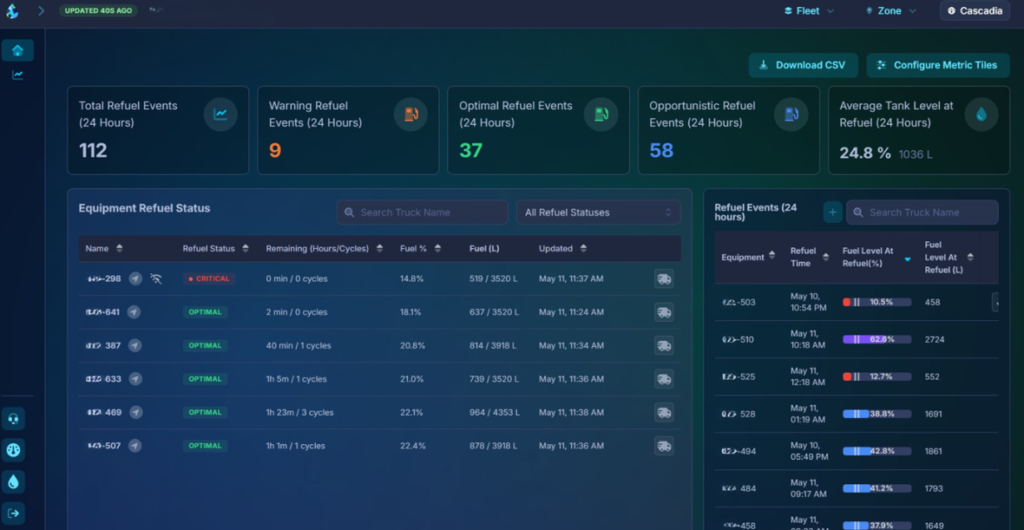
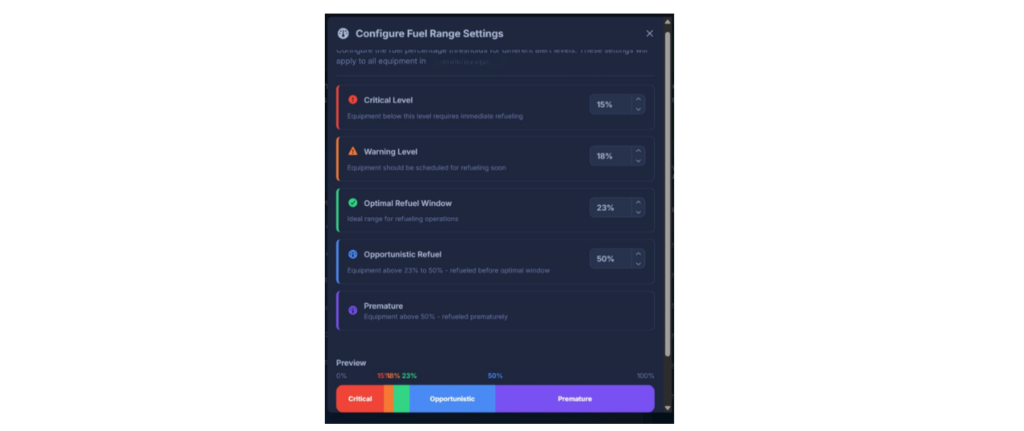
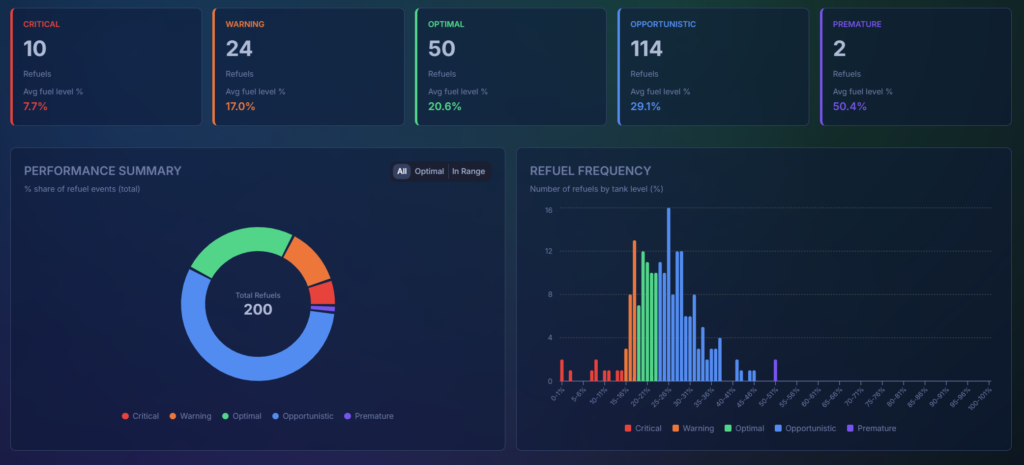
In larger mines with dedicated fuel dispatchers, or in mines without existing FMS refuel dispatch capabilities, miners may choose to use Cascadia Scientific’s Refuel Coach Interface. The system is configured to identify fuel tank regions (Premature, opportunistic, Optimal, Warning, & Critical). In over-trucked scenarios the refuel window is open in the opportunistic region, and when mining is limited by truck availability the refuel window opens in the optimal range. The system provides filtering by truck fleet and mining area and can also revert to a conservative time-based model for specific trucks with compounding hardware problems. Limited information related to fuel island availability is also provided to support a dispatch decision.
Refuel Coach Performance Dashboard
Regardless of the dispatching tool, customer in pursuit of optimal refuelling gains will find value in the Refuel Coach performance dashboard. This area of the tool analyses past refuel performance and presents statistics for average fuel on board at time of Refuel, the percentage of refuel events completed in the optimal window and the number of recovered hours and additional material movement relative to baseline performance.
In Conclusion
Safely optimized refuel dispatch gives mine operators a practical way to recover productive time that is already sitting in the tank. By replacing conservative time-based assumptions with trusted, multi-source fuel intelligence, sites can reduce unnecessary refuel stops, lower queuing pressure on fueling infrastructure, and materially improve haulage output without compromising safety. The result is a rare operational win: higher productivity, lower disruption, and better protection against costly run-to-empty events—all achieved through smarter use of data and tighter integration with existing dispatch processes.
Contact Cascadia Scientific for a free assessment of your current refuel practice and to learn more about refuel coach and the possibility of a positive return on investment guarantee.